Unravelling the Molecular Network Structure of Biohybrid Hydrogels

Glycosaminoglycan-based biohybrid hydrogels are highly promising materials for tissue engineering and regenerative medicine due to their ability to provide cell-instructive environments. In this article, Jana Sievers-Liebschner, Ron Dockhorn, Jens Friedrichs, Thomas Kurth, Peter Fratzl, Jens-Uwe Sommer, Carsten Werner, and Uwe Freudenberg investigate the nanoscale molecular network structure of these hydrogels using an integrated analytical approach.

The study combines transmission electron microscopy, X-ray scattering, computer simulations, and AFM-based nanoindentation to quantitatively characterize nanoscale polymer network connectivity and structural inhomogeneities. These parameters are essential for understanding hydrogel mechanics, growth factor delivery, and cell–material interactions relevant to regenerative therapies and organoid culture systems.

Atomic force microscopy (AFM)-based nanoindentation measurements were performed to determine the mechanical stiffness of the hydrogels in both PBS and ethanol environments. Measurements were conducted using a modified NanoWorld PNP-TR-TL-Au AFM probe equipped with a 10 μm silica bead for colloidal probe nanoindentation.

Nanoindentation experiments were carried out using a set point of 6 nN and an approach/retract velocity of 5 μm/s. At least 70 force–distance curves were recorded for each sample at different positions across the hydrogel surface. Young’s modulus values were extracted using the Hertz model, enabling quantitative evaluation of hydrogel nanomechanical properties.

This work demonstrates how AFM-based nanoindentation with a NanoWorld AFM probe contributes to the detailed characterization of biohybrid hydrogel networks and supports the development of engineered matrices for biomedical applications.


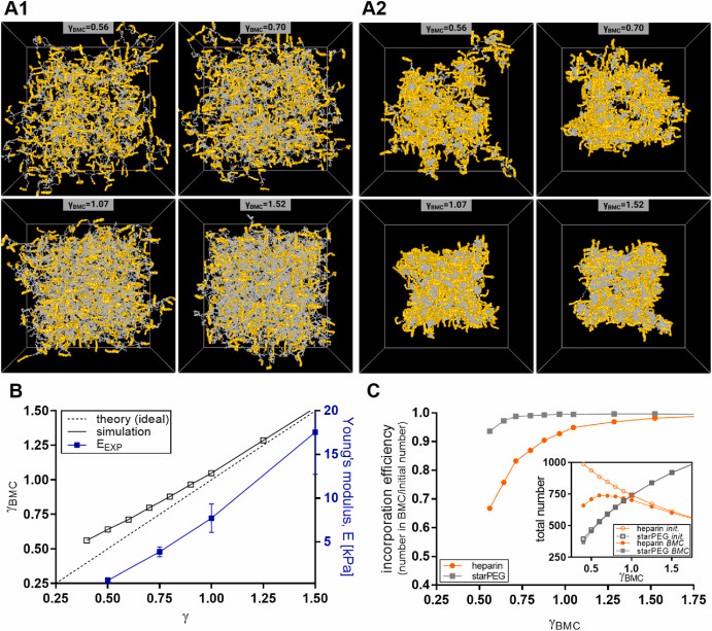
Fig. 5. Computational modelling of starPEG-heparin hydrogel networks
Fig. 5. Computational modelling of starPEG-heparin hydrogel networks. A: Simulation snapshots of hydrated and dehydrated starPEG-heparin hydrogels. For the hydrated network (A1), a good solvent (equivalent to PBS) was assumed. To model the dehydrated state (A2), parameters were adjusted to promote the self-aggregation of starPEG molecules in a poor solvent (e.g., ethanol). Networks with different effective molar ratios after crosslinking (γBMC, where BMC is the Biggest Molecule Cluster) are shown, assuming a 90 % extent of reaction between starPEG (grey) and heparin (yellow). Cube size: L = 150 nm. B: Molar ratio of the BMC γBMC after crosslinking at an extent of reaction p = 0.9, plotted as a function of the initial molar ratio. The dotted line represents the theoretical ideal value, while the blue line shows the experimentally determined Young’s moduli as a function of crosslinking degree. C: Incorporation efficiency of starPEG and heparin within the BMC, calculated as the number of starPEG or heparin molecules in the BMC divided by the number in the reaction mixture (ideal network). Insert: Total number of starPEG or heparin molecules in the reaction mixture (initial) or within the BMC. (For interpretation of the references to colour in this figure legend, the reader is referred to the Web version of this article.)


Full citation:
Sievers-Liebschner, J.; Dockhorn, R.; Friedrichs, J.; Kurth, T.; Fratzl, P.; Sommer, J.-U.; Werner, C.; Freudenberg, U.
Unravelling the molecular network structure of biohybrid hydrogels.
Materials Today Bio 2025, 34, 102249.
https://doi.org/10.1016/j.mtbio.2025.102249

Copyright © 2026 Elsevier B.V.

Does the Hfq Protein Contribute to RNA Cargo Translocation into Bacterial Outer Membrane Vesicles?

Gram-negative bacteria release outer membrane vesicles (OMVs) that play a central role in host–pathogen interactions by transporting biomolecules, including proteins and nucleic acids. In this article, Marisela Velez and Véronique Arluison investigate the role of the RNA chaperone Hfq in mediating the interaction of small regulatory RNAs (sRNAs) with bacterial membranes.

In this article, it is shown that RNA binding to the inner membrane of Escherichia coli occurs in an Hfq-dependent manner. The study further demonstrates that membrane composition is a key factor in this process, with cardiolipin-rich lipid domains significantly enhancing RNA–membrane interactions. These findings provide new insight into the mechanism of RNA translocation from the cytoplasm to the periplasm, supporting its subsequent incorporation into OMVs.

Atomic force microscopy (AFM) was used to verify the formation and integrity of supported lipid bilayers and to monitor peptide–membrane interactions. Imaging was performed in tapping mode using a NanoWorld PNP-DB AFM probe with a resonance frequency of 15 kHz and a spring constant of 0.48 N/m. Measurements were carried out in liquid environment, enabling high-resolution characterization of biologically relevant membrane structures.

This work highlights the importance of AFM-based analysis for studying lipid–protein interactions and provides new understanding of RNA transport mechanisms in bacterial systems.

Figure 1
E. coli lipid bilayer incubated in the absence (A) or presence (B) of Hfq-CTR. Panel (A) shows the E. coli lipids bilayer. The height profile under the line shown on the upper image indicates that the domains are 0.8 nm higher than the rest of the membrane. The lower panel shows a three-dimensional representation of a small region. Panel (B) shows the E. coli lipid bilayer incubated in the presence of Hfq-CTR. The peptide accumulated on top of some of the domains, generating 1 nm high regions in some of them, as shown on the height profile. The arrows point the regions where the change in height occurs.

Full citation:
Velez, M.; Arluison, V.
Does the Hfq Protein Contribute to RNA Cargo Translocation into Bacterial Outer Membrane Vesicles?
Pathogens 2025, 14(4), 399.

https://doi.org/10.3390/pathogens14040399

License: CC BY 4.0 (https://creativecommons.org/licenses/by/4.0/)


Structural Elucidation of Citric Acid Cross-Linked Pectin and Its Impact on the Properties of Nanocellulose-Reinforced Packaging Films

Citric acid cross-linking is an effective strategy for modifying citrus pectin to enhance its performance in sustainable packaging applications. In this article, Chandra Mohan Chandrasekar, Daniele Carullo, Francesco Saitta, Tommaso Bellesia, Elena Caneva, Chiara Baschieri, Marco Signorelli, Dimitrios Fessas, Stefano Farris and Davide Romano, investigated the structural changes induced by citric acid cross-linking and their influence on the properties of nanocellulose-reinforced packaging films..

The authors demonstrated that cross-linking significantly alters the structure–property relationship of the biopolymer matrix, leading to improved film integrity and modified surface morphology. These results provide valuable insight into biopolymer modification strategies for the development of environmentally friendly packaging materials.

Atomic force microscopy (AFM) was employed to characterize the surface morphology of the films. Measurements were performed using a commercially available AFM instrument operated in contact resonance amplitude imaging (CRAI) mode. A NanoWorld Arrow-FMR AFM probe was used.

This AFM probe features a rectangular beam with a triangular free end and a tetrahedral tip (tip radius ~10 nm, tip height 10–15 μm), with a spring constant of 2.8 N/m and a resonance frequency of 75 kHz. Root mean square surface roughness values were calculated from at least five height-mode images.

Fig. 3. 2D synchronized correlation analysis of FTIR spectra for CLCP packaging film trials.
Fig. 3. 2D synchronized correlation analysis of FTIR spectra for CLCP packaging film trials. [The intensity of the auto-peaks on the diagonal line represents the overall change in spectral intensity. The key region of interest is the strong auto-peak around 1700 cm−1, highlighted by

Full citation: Chandrasekar, C. M.; Carullo, D.; Saitta, F.; Bellesia, T.; Caneva, E.; Baschieri, C.; Signorelli, M.; Fessas, D.; Farris, S.; Romano, D. “Structural elucidation of citric acid cross-linked pectin and its impact on the properties of nanocellulose-reinforced packaging films.” International Journal of Biological Macromolecules 2025, 333(2), 148869. https://doi.org/10.1016/j.ijbiomac.2025.148869

Attribution 4.0 International By exercising the Licensed Rights (defined below), You accept and agree to be bound by the terms and conditions of this Creative Commons Attribution 4.0 International Public License (“Public License”). To the extent this Public License may be interpreted as a contract, You are granted the Licensed Rights in consideration of Your acceptance of these terms and conditions, and the Licensor grants You such rights in consideration of benefits the Licensor receives from making the Licensed Material available under these terms and conditions. https://creativecommons.org/licenses/by/4.0/legalcode.en