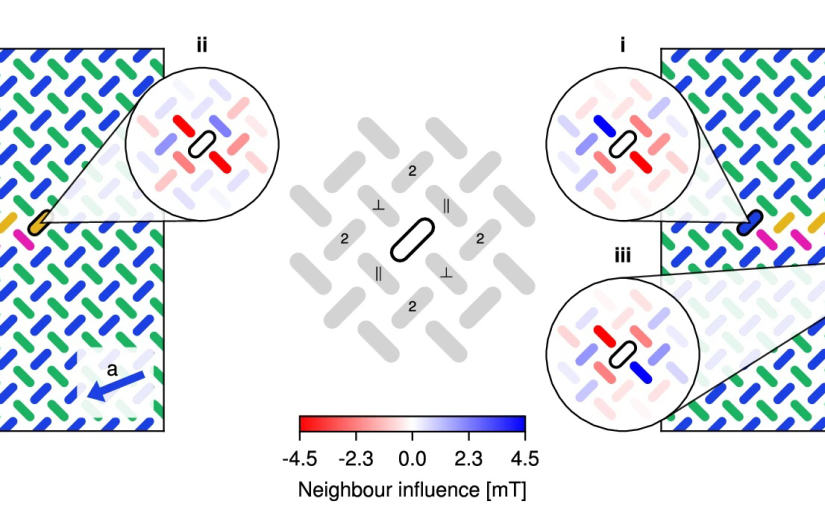
Artificial Spin Ice (ASI) has emerged as a fascinating platform for studying collective behaviour in interacting nanomagnets, with potential applications ranging from magnetic devices to neuromorphic computing. In this article, Arthur Penty, Johannes H. Jensen, Ida Breivik, Anders Strømberg, Erik Folven, and Gunnar Tufte demonstrate how a mobile magnetic structure — a “snake” glider — can be created and precisely controlled within a nanomagnetic metamaterial.
Inspired by the concept of gliders in Cellular Automata, the researchers use an evolutionary algorithm to discover a simple moving structure within a pinwheel Artificial Spin Ice system. The resulting snake can move through the nanomagnetic array under a global magnetic-field protocol, allowing controlled manipulation of magnetic textures on a scale of approximately 100 nm.
Artificial Spin Ice as a Platform for Information Processing
Artificial Spin Ice consists of interacting nanomagnets arranged in a two-dimensional lattice. These nanoscale magnetic elements can exhibit collective states and emergent behaviour, making ASI attractive for exploring unconventional approaches to information processing.
A key challenge is integrating information transformation, transmission, and storage into the same physical system. The snake glider introduced in this article addresses this challenge by providing a controllable magnetic structure that can move through the ASI lattice while retaining its functionality.
The researchers demonstrate that the snake can move either left or right depending on its orientation. Its motion is controlled through a sequence of in-plane magnetic fields, while simulations and experiments are used to investigate the mechanism responsible for the glider’s movement and its robustness against disorder.
NanoWorld MFMR for Magnetic Force Microscopy
Experimental investigation of the nanomagnetic structures was performed using NanoWorld POINTPROBE MFMR, a magnetic force microscopy AFM probe designed for magnetic imaging.
The NanoWorld MFMR was used for both writing the initial magnetic state and imaging the resulting magnetic structures. To initialise the snake, the MFM probe was used to write an approximately 1 µm magnetic line in the pinwheel Artificial Spin Ice while a 10 mT bias field was applied. The writing process was performed with the MFM probe in contact with the sample at a scan speed of 55 µm/s.
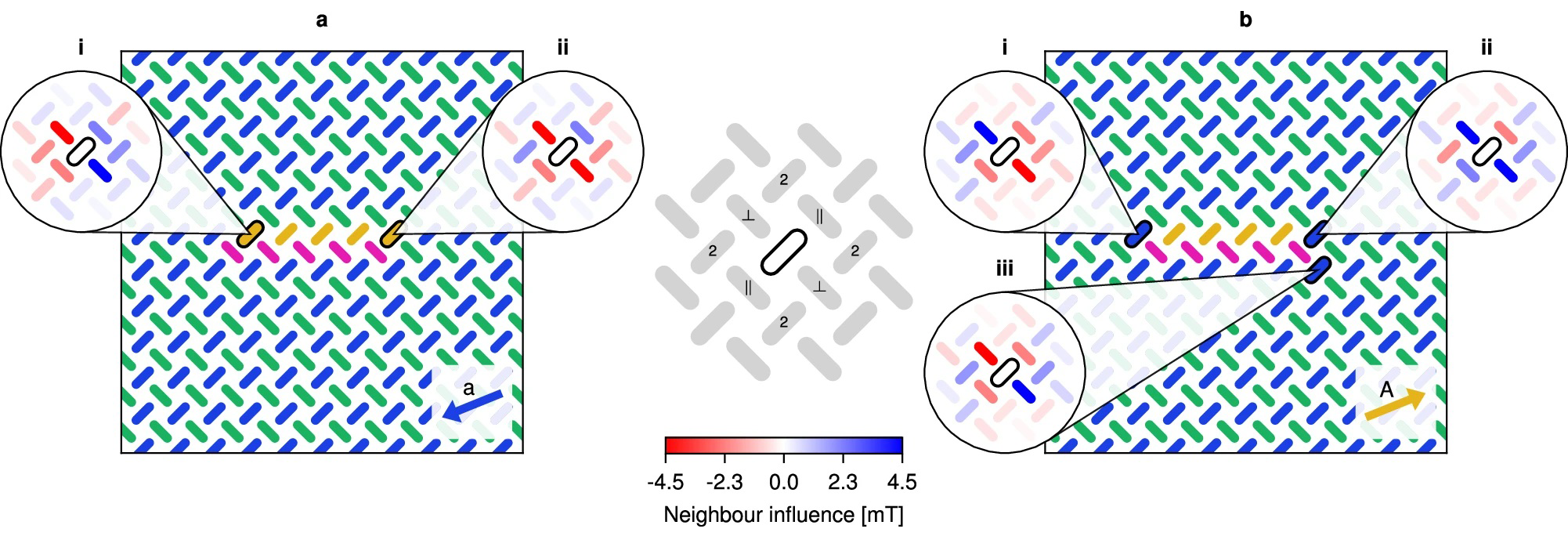
Following magnetic-field-driven evolution of the structure, the researchers used MFM to image the magnetic state after each applied field. Imaging was performed at remanence using a lift height between 55 and 60 nm and scan speeds between 50 and 55 µm/s. All experiments were conducted at room temperature.
These measurements allowed the researchers to directly observe how the magnetic texture evolved as the snake moved through the nanomagnetic array.
Imaging a Controllable Magnetic Texture
The experimental MFM results provide a direct view of the magnetic states underlying the glider behaviour. By repeatedly applying the field protocol and imaging the resulting configurations, the researchers could track the movement of individual snakes and investigate how their structure responds to the magnetic environment.
The experiments also demonstrated the robustness of the concept. Multiple snakes could be initialised within the same Artificial Spin Ice array while maintaining sufficient separation to avoid unwanted interactions. The researchers further investigated how fabrication disorder affects the movement of the gliders, finding evidence of self-correction and graceful degradation before motion eventually breaks down.
The combination of experimental MFM imaging and micromagnetic simulations provides a detailed picture of the mechanism behind the snake’s movement. This makes the approach particularly interesting for studying how local magnetic interactions can be harnessed to produce controlled, collective behaviour.
From Magnetic Gliders to Neuromorphic Computing
The snake glider provides more than a visually compelling magnetic structure. Because its position and movement can be controlled, it can act as a physical carrier of information within the Artificial Spin Ice substrate.
The researchers demonstrate how the glider can contribute to information transmission, storage, and transformation, potentially allowing these functions to be integrated into a single magnetic material. Such concepts could contribute to the development of ultra-low-power computing architectures based on nanoscale magnetic states rather than conventional electronic switching.
For this type of research, high-quality MFM probes are
essential for resolving and manipulating nanoscale magnetic structures. The NanoWorld POINTPROBE MFMR provides a dedicated solution for magnetic force microscopy, enabling both magnetic writing and high-resolution imaging of nanomagnetic systems.
The work by Penty and co-authors demonstrates how MFM can do more than simply characterise magnetic materials: it can become an experimental tool for exploring programmable magnetic textures, emergent behaviour, and new approaches to information processing.
Full citation:
Penty, A.; Jensen, J. H.; Breivik, I.; Strømberg, A.; Folven, E.; Tufte, G.
Controllable gliders in a nanomagnetic metamaterial.
Nature Communications 2025, 16, 7500.
DOI: 10.1038/s41467-025-62515-1
License: CC BY 4.0