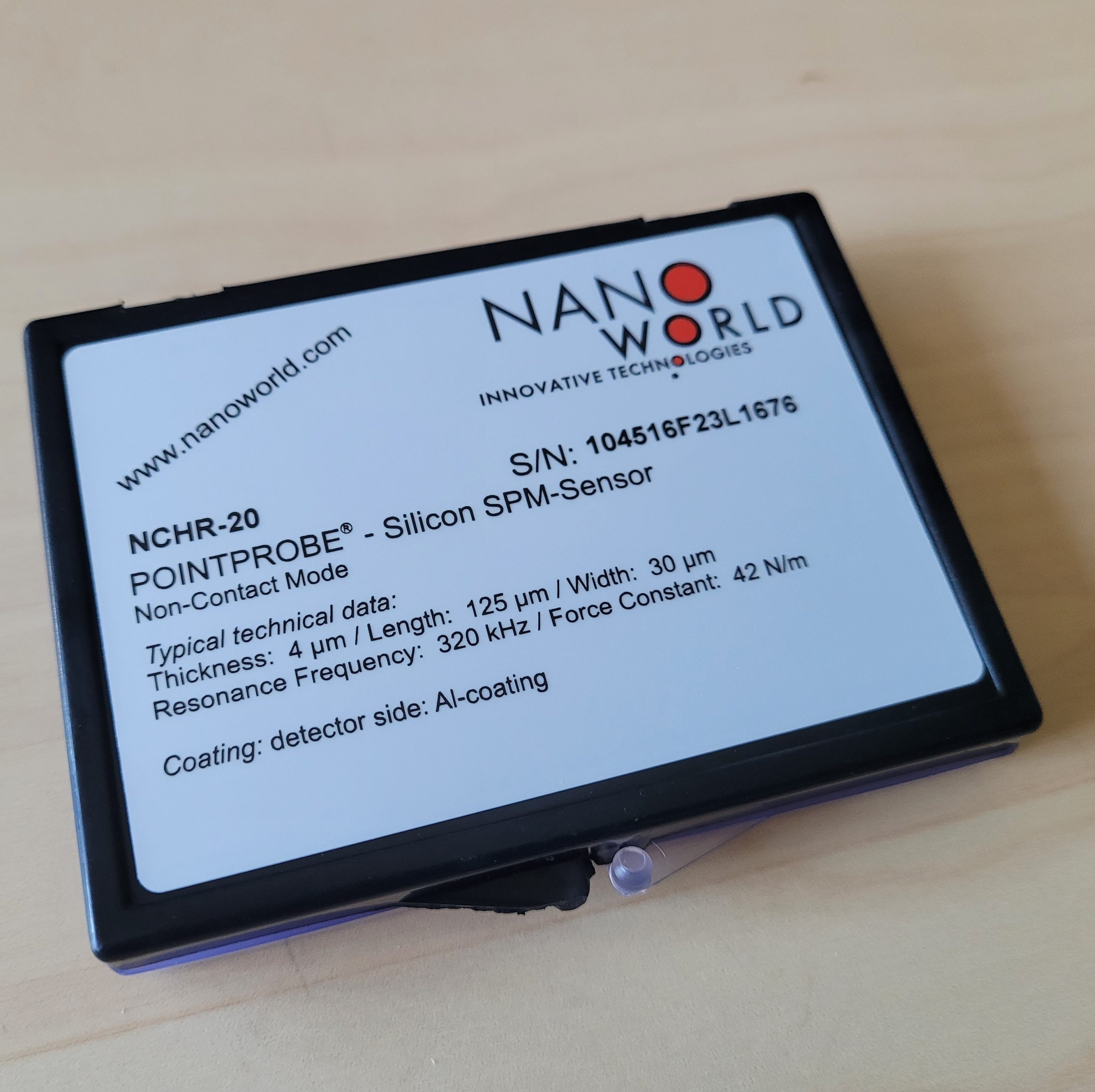
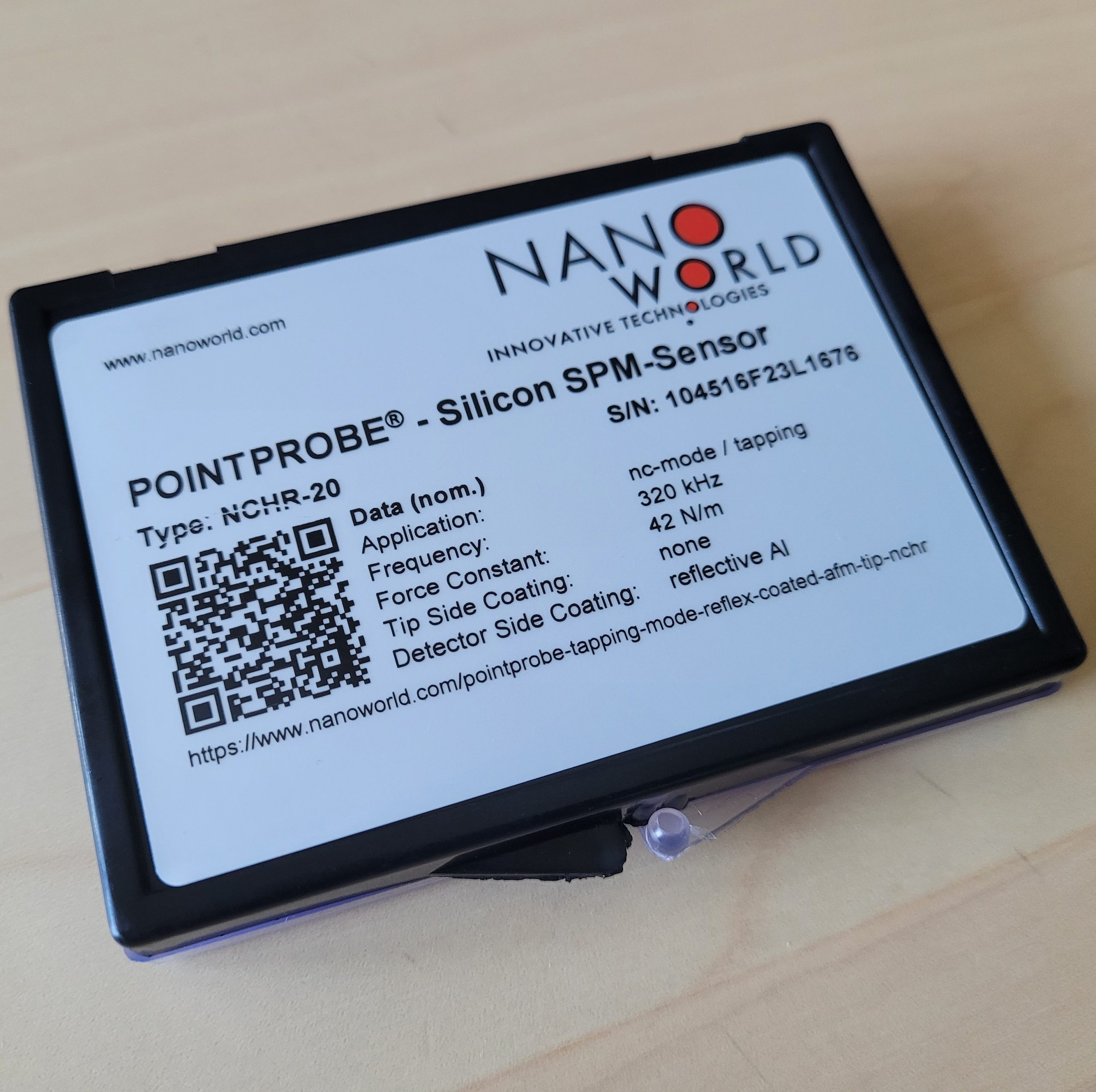
Starting August 1, 2026, NanoWorld will begin introducing updated designs for many of our product labels.
During the transition period, you may receive products with either the current or the new label design shown below. The label version simply reflects the ongoing implementation of our new labeling system and is not related to the product itself or its date of manufacture.
The updated labels continue to display the nominal resonant frequency and nominal force constant of each AFM probe and now include a QR code linking directly to the corresponding product page. This provides convenient access to the complete set of available AFM probe specifications and related technical product information.
Products with multiple cantilevers (such as the Pyrex-Nitride Series) and customized products will continue to use their current labels, reflecting their specific labeling requirements.
While the labels are changing, the AFM probes themselves remain the same. We hope this update makes it even more convenient to access product information when you need it.
Current product label for NanoWorld AFM probes.Updated product label for NanoWorld AFM probes featuring a QR code linking to the corresponding product page.
Sustainable alternatives to conventional plastic packaging are receiving increasing attention as industries seek circular economy solutions and renewable material sources. In this article, Tommaso Bellesia, Daniele Carullo, Andrea Fachin, Maral Soltanzadeh, Masoud Ghaani, Giorgio Innocenzo Ascrizzi, Laura Piazza, and Stefano Farris investigate the potential of microfibrillated cellulose (MFC) obtained from agri-food waste streams and plant residues as high-performance materials for food packaging applications.
The authors produced MFC dispersions from giant cane, Posidonia oceanica seagrass, and coffee silverskin using high-pressure homogenization and compared the resulting films with a commercially available cellulose-based packaging material. An extensive characterization of the dispersions and films was performed, including rheological, mechanical, optical, barrier, surface, and morphological analyses.
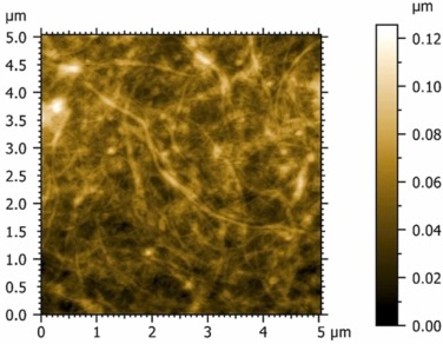
In this article, atomic force microscopy (AFM) confirmed the successful production of microfibrillated cellulose structures with average fibril diameters below 100 nm. The resulting films demonstrated excellent oxygen barrier performance, high stiffness, strong tensile properties, and effective UV-shielding capabilities. Among the investigated materials, films produced from coffee silverskin exhibited particularly promising performance, highlighting the potential of converting agricultural by-products into value-added packaging materials.
To investigate film surface topography, AFM measurements were performed in contact resonance amplitude imaging mode using a NanoWorld Arrow-FMR AFM probe. The AFM probe features a rectangular cantilever with a triangular free end and a tetrahedral tip with a typical radius of curvature of approximately 10 nm. With a spring constant of 2.8 N/m and a resonance frequency of 75 kHz, the Arrow-FMR AFM probe enabled detailed nanoscale characterization of film morphology and surface roughness.
The study demonstrates how AFM analysis using a NanoWorld AFM probe contributes to understanding the relationship between cellulose microstructure and the functional performance of sustainable packaging materials. The results further support the development of renewable, high-performance cellulosic thin films derived from waste biomass sources.
Figure 1Fig. 1. AFM height image of MFC from PO-derived cellulose.
Full citation:
Bellesia, T.; Carullo, D.; Fachin, A.; Soltanzadeh, M.; Ghaani, M.; Ascrizzi, G. I.; Piazza, L.; Farris, S. Microfibrillated cellulose films from agri-food wastes and plant residues for food packaging applications – A comparative investigation.
Food Packaging and Shelf Life 2026, 54, 101728. https://doi.org/10.1016/j.fpsl.2026.101728
Attribution 4.0 International
https://creativecommons.org/licenses/by/4.0/
Gram-negative bacteria release outer membrane vesicles (OMVs) that play a central role in host–pathogen interactions by transporting biomolecules, including proteins and nucleic acids. In this article, Marisela Velez and Véronique Arluison investigate the role of the RNA chaperone Hfq in mediating the interaction of small regulatory RNAs (sRNAs) with bacterial membranes.
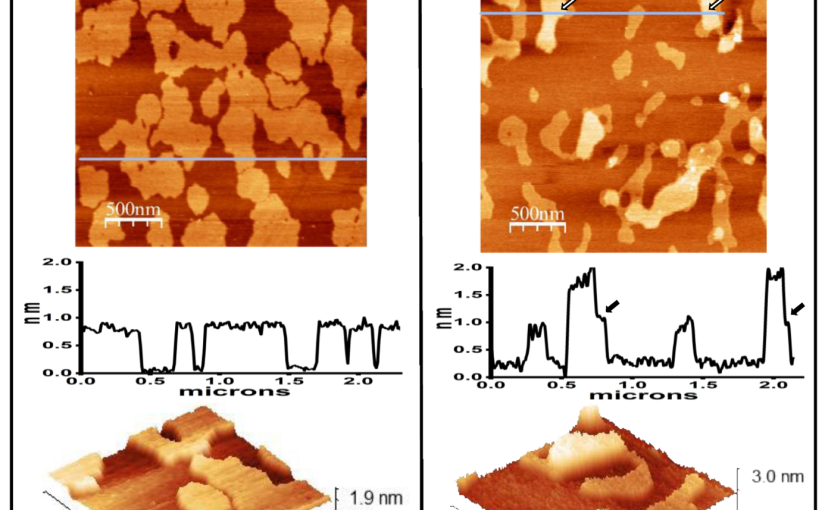
In this article, it is shown that RNA binding to the inner membrane of Escherichia coli occurs in an Hfq-dependent manner. The study further demonstrates that membrane composition is a key factor in this process, with cardiolipin-rich lipid domains significantly enhancing RNA–membrane interactions. These findings provide new insight into the mechanism of RNA translocation from the cytoplasm to the periplasm, supporting its subsequent incorporation into OMVs.
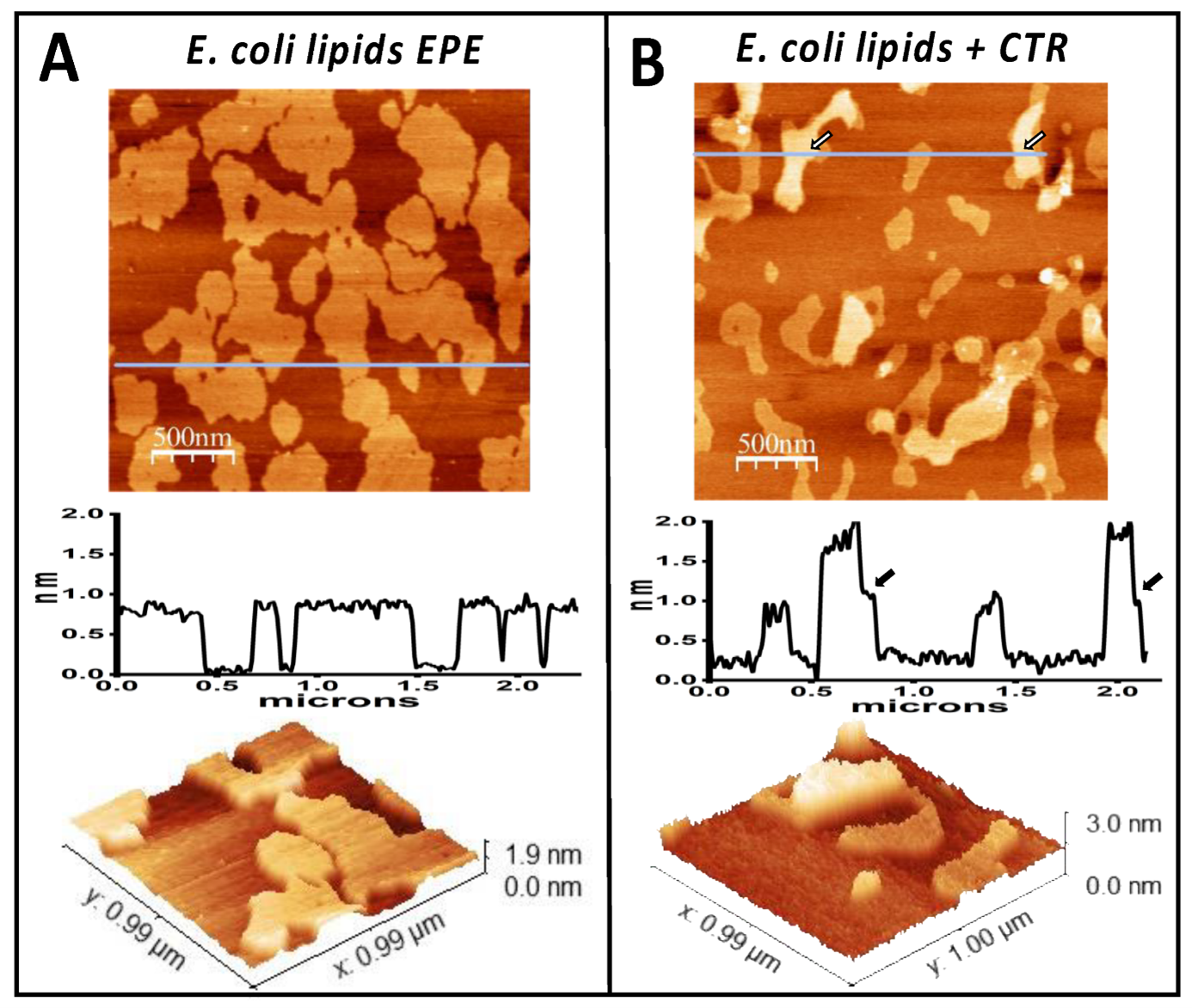
Atomic force microscopy (AFM) was used to verify the formation and integrity of supported lipid bilayers and to monitor peptide–membrane interactions. Imaging was performed in tapping mode using a NanoWorld Pyrex-Nitride PNP-DB AFM probe with a resonance frequency of 15 kHz and a spring constant of 0.48 N/m. Measurements were carried out in liquid environment, enabling high-resolution characterization of biologically relevant membrane structures.
This work highlights the importance of AFM-based analysis for studying lipid–protein interactions and provides new understanding of RNA transport mechanisms in bacterial systems.
Figure 1 E. coli lipid bilayer incubated in the absence (A) or presence (B) of Hfq-CTR. Panel (A) shows the E. coli lipids bilayer. The height profile under the line shown on the upper image indicates that the domains are 0.8 nm higher than the rest of the membrane. The lower panel shows a three-dimensional representation of a small region. Panel (B) shows the E. coli lipid bilayer incubated in the presence of Hfq-CTR. The peptide accumulated on top of some of the domains, generating 1 nm high regions in some of them, as shown on the height profile. The arrows point the regions where the change in height occurs.
Full citation:
Velez, M.; Arluison, V. Does the Hfq Protein Contribute to RNA Cargo Translocation into Bacterial Outer Membrane Vesicles?
Pathogens 2025, 14(4), 399. https://doi.org/10.3390/pathogens14040399
License: CC BY 4.0 (https://creativecommons.org/licenses/by/4.0/)