
Structural Elucidation of Citric Acid Cross-Linked Pectin and Its Impact on the Properties of Nanocellulose-Reinforced Packaging Films

Citric acid cross-linking is an effective strategy for modifying citrus pectin to enhance its performance in sustainable packaging applications. In this article, Chandra Mohan Chandrasekar, Daniele Carullo, Francesco Saitta, Tommaso Bellesia, Elena Caneva, Chiara Baschieri, Marco Signorelli, Dimitrios Fessas, Stefano Farris and Davide Romano, investigated the structural changes induced by citric acid cross-linking and their influence on the properties of nanocellulose-reinforced packaging films..

The authors demonstrated that cross-linking significantly alters the structure–property relationship of the biopolymer matrix, leading to improved film integrity and modified surface morphology. These results provide valuable insight into biopolymer modification strategies for the development of environmentally friendly packaging materials.

Atomic force microscopy (AFM) was employed to characterize the surface morphology of the films. Measurements were performed using a commercially available AFM instrument operated in contact resonance amplitude imaging (CRAI) mode. A NanoWorld Arrow-FMR AFM probe was used.

This AFM probe features a rectangular beam with a triangular free end and a tetrahedral tip (tip radius ~10 nm, tip height 10–15 μm), with a spring constant of 2.8 N/m and a resonance frequency of 75 kHz. Root mean square surface roughness values were calculated from at least five height-mode images.
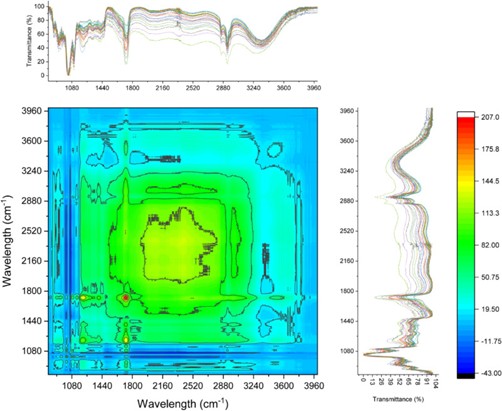
Fig. 3. 2D synchronized correlation analysis of FTIR spectra for CLCP packaging film trials.
Fig. 3. 2D synchronized correlation analysis of FTIR spectra for CLCP packaging film trials. [The intensity of the auto-peaks on the diagonal line represents the overall change in spectral intensity. The key region of interest is the strong auto-peak around 1700 cm−1, highlighted by

Full citation: Chandrasekar, C. M.; Carullo, D.; Saitta, F.; Bellesia, T.; Caneva, E.; Baschieri, C.; Signorelli, M.; Fessas, D.; Farris, S.; Romano, D. “Structural elucidation of citric acid cross-linked pectin and its impact on the properties of nanocellulose-reinforced packaging films.” International Journal of Biological Macromolecules 2025, 333(2), 148869. https://doi.org/10.1016/j.ijbiomac.2025.148869

Attribution 4.0 International By exercising the Licensed Rights (defined below), You accept and agree to be bound by the terms and conditions of this Creative Commons Attribution 4.0 International Public License (“Public License”). To the extent this Public License may be interpreted as a contract, You are granted the Licensed Rights in consideration of Your acceptance of these terms and conditions, and the Licensor grants You such rights in consideration of benefits the Licensor receives from making the Licensed Material available under these terms and conditions. https://creativecommons.org/licenses/by/4.0/legalcode.en
Nonlinear Optical Response in Layer-Stacked Gallenene with Ferroelectric Polarization

Layer-stacked gallenene is an emerging two-dimensional material with unique structural and electronic propertiesIn this article, M.Yunusa, A. K.Schulz, T.Parker, et al. investigated the nonlinear optical response of layer-stacked gallenene exhibiting ferroelectric polarization. The material was produced using a liquid metal-based synthesis approach and showed a phase transition associated with its stacked structure.

The authors demonstrated strong second harmonic generation (SHG) signals, revealing the nonlinear optical activity of gallenene and confirming its ferroelectric nature. These findings highlight the potential of gallenene as a novel functional 2D material for advanced optoelectronic and photonic applications.

Atomic force microscopy (AFM) was used to characterize transparent lamellar films and helical filaments. Measurements were performed using a commercially available AFM instrument operated in contact mode. A NanoWorld Arrow-CONTR AFM probe with a nominal force constant of 0.2 N/m and a resonance frequency of 14 kHz was used to obtain high-resolution surface morphology data.


Figure 1
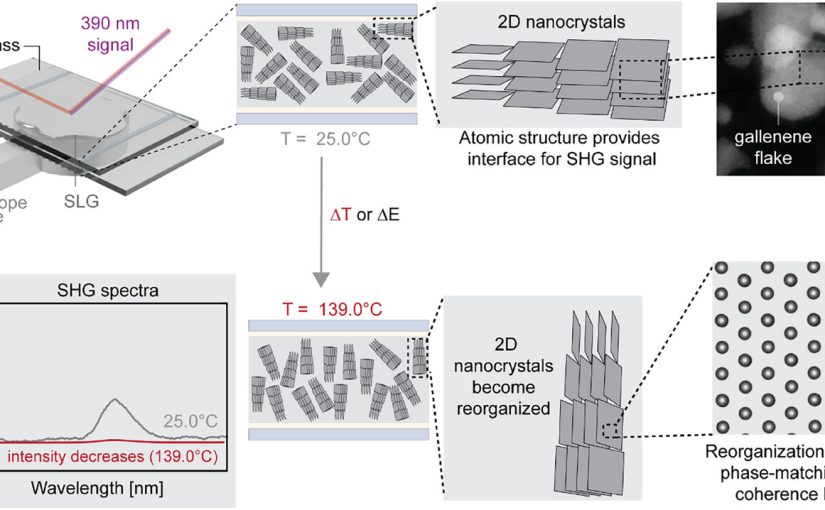
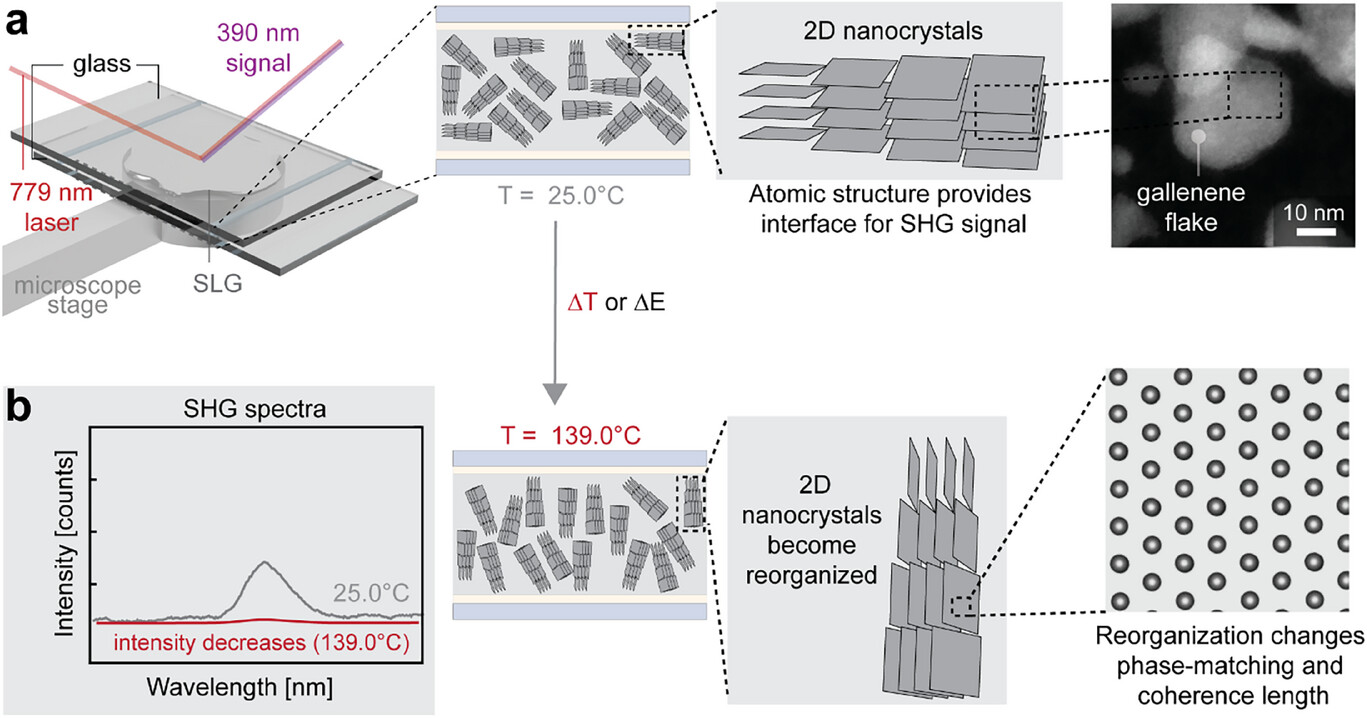
Structure of gallenene and complex anatomy of supercooled liquid gallium. Mechanism for electrical and thermal perturbation. a) Illustration of hypothesized interaction of SHG response with SLG in linearly polarized light showing that thermal perturbations could align the 2D nanocrystals, allowing for an increased SHG medium at either temperature or electrical fields. An example HAADF image of gallenene flake sandwiched between two graphene layers, as depicted in (a) (far right microscope image). b) Structural reorganization of gallenene nanocrystals in the SLG leading to an intensity change in SHG signal as a result of thermal or electrical perturbation.

Full citation:

Yunusa, M.; Schulz, A. K.; Parker, T.; Schneider, F.; Elibol, K.; Predel, M.; Dzíbelová, J.; Rebmann, M.; Gorkan, T.; Ye, J.; Tan, J.-C.; Kang, W.; van Aken, P. A.; Meixner, A. J.; Durgun, E.; Kotakoski, J.; Zhang, D.; Sitti, M. Nonlinear Optical Response in Layer-Stacked Gallenene with Ferroelectric Polarization.

Advanced Materials 2025, 37(44), e01058.

https://doi.org/10.1002/adma.202501058

Attribution 4.0 International By exercising the Licensed Rights (defined below), You accept and agree to be bound by the terms and conditions of this Creative Commons Attribution 4.0 International Public License (“Public License”). To the extent this Public License may be interpreted as a contract, You are granted the Licensed Rights in consideration of Your acceptance of these terms and conditions, and the Licensor grants You such rights in consideration of benefits the Licensor receives from making the Licensed Material available under these terms and conditions. https://creativecommons.org/licenses/by/4.0/


Effect of Staple Age on DNA Origami Nanostructure Assembly and Stability

DNA origami nanostructures are widely employed in various areas of fundamental and applied research. Due to the tremendous success of the DNA origami technique in the academic field, considerable efforts currently aim at the translation of this technology from a laboratory setting to real-world applications, such as nanoelectronics, drug delivery, and biosensing. While many of these real-world applications rely on an intact DNA origami shape, they often also subject the DNA origami nanostructures to rather harsh and potentially damaging environmental and processing conditions.*

In their article “Effect of Staple Age on DNA Origami Nanostructure Assembly and Stability” Charlotte Kielar, Yang Xin, Xiaodan Xu, Siqi Zhu, Nelli Gorin , Guido Grundmeier, Christin Möser, David M. Smith and Adrian Keller investigate the effect of long-term storage of the employed staple strands on DNA origami assembly and stability.*

Atomic force microscopy (AFM) under liquid and dry conditions was employed to characterize the structural integrity of Rothemund triangles assembled from different staple sets that have been stored at −20 °C for up to 43 months.*

NanoWorld Ultra-Short Cantilevers USC-F0.3-k0.3 were the AFM probes that were used for the AFM measurements under liquid conditions.*

Figure 1. from “Effect of Staple Age on DNA Origami Nanostructure Assembly and Stability” by Charlotte Kielar et al.
(a) Schematic illustration of the Rothemund triangle DNA origami. AFM images of DNA origami triangles assembled from staple sets aged for (b) 2–7 months, (c) 11–16 months, (d) 22–27 months, and (e) 38–43 months. Measurements were performed either in liquid (left column) or dry conditions after gently dipping the sample into water (central column) or after harsh rinsing (right column). Scale bars represent 250 nm. Height scales are given in the individual images. The insets show zooms of individual DNA origami triangles.

*Charlotte Kielar, Yang Xin, Xiaodan Xu, Siqi Zhu, Nelli Gorin , Guido Grundmeier, Christin Möser, David M. Smith and Adrian Keller
Effect of Staple Age on DNA Origami Nanostructure Assembly and Stability
Molecules 2019, 24(14), 2577
doi: https://doi.org/10.3390/molecules24142577

Please follow this external link to the full article: https://www.mdpi.com/1420-3049/24/14/2577/htm

Open Access: The article « Effect of Staple Age on DNA Origami Nanostructure Assembly and Stability » by Charlotte Kielar, Yang Xin, Xiaodan Xu, Siqi Zhu, Nelli Gorin , Guido Grundmeier, Christin Möser, David M. Smith and Adrian Keller is licensed under a Creative Commons Attribution 4.0 International License, which permits use, sharing, adaptation, distribution and reproduction in any medium or format, as long as you give appropriate credit to the original author(s) and the source, provide a link to the Creative Commons license, and indicate if changes were made. The images or other third party material in this article are included in the article’s Creative Commons license, unless indicated otherwise in a credit line to the material. If material is not included in the article’s Creative Commons license and your intended use is not permitted by statutory regulation or exceeds the permitted use, you will need to obtain permission directly from the copyright holder. To view a copy of this license, visit http://creativecommons.org/licenses/by/4.0/.