
Does the Hfq Protein Contribute to RNA Cargo Translocation into Bacterial Outer Membrane Vesicles?

Gram-negative bacteria release outer membrane vesicles (OMVs) that play a central role in host–pathogen interactions by transporting biomolecules, including proteins and nucleic acids. In this article, Marisela Velez and Véronique Arluison investigate the role of the RNA chaperone Hfq in mediating the interaction of small regulatory RNAs (sRNAs) with bacterial membranes.

In this article, it is shown that RNA binding to the inner membrane of Escherichia coli occurs in an Hfq-dependent manner. The study further demonstrates that membrane composition is a key factor in this process, with cardiolipin-rich lipid domains significantly enhancing RNA–membrane interactions. These findings provide new insight into the mechanism of RNA translocation from the cytoplasm to the periplasm, supporting its subsequent incorporation into OMVs.

Atomic force microscopy (AFM) was used to verify the formation and integrity of supported lipid bilayers and to monitor peptide–membrane interactions. Imaging was performed in tapping mode using a NanoWorld PNP-DB AFM probe with a resonance frequency of 15 kHz and a spring constant of 0.48 N/m. Measurements were carried out in liquid environment, enabling high-resolution characterization of biologically relevant membrane structures.

This work highlights the importance of AFM-based analysis for studying lipid–protein interactions and provides new understanding of RNA transport mechanisms in bacterial systems.
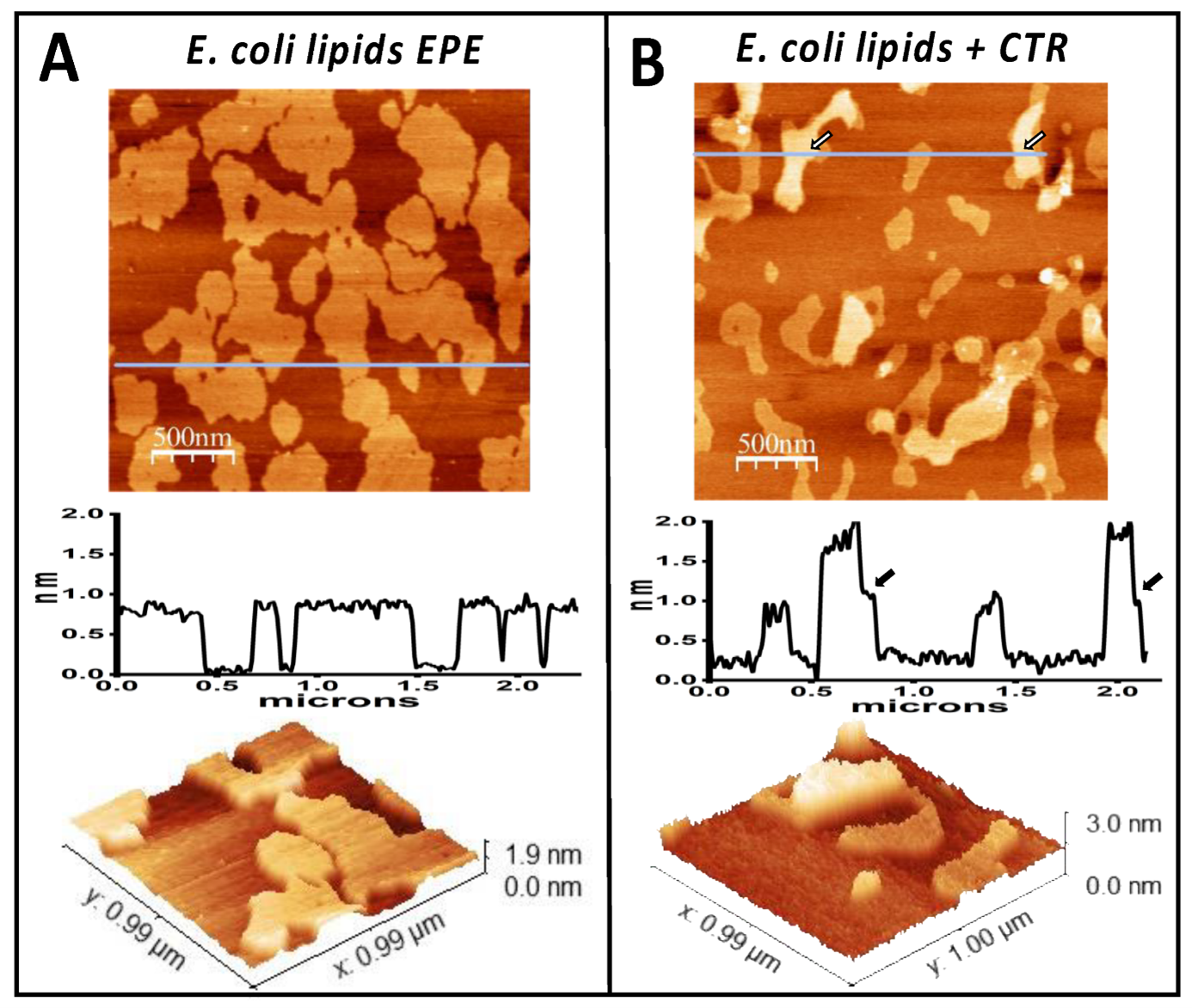
Figure 1
E. coli lipid bilayer incubated in the absence (A) or presence (B) of Hfq-CTR. Panel (A) shows the E. coli lipids bilayer. The height profile under the line shown on the upper image indicates that the domains are 0.8 nm higher than the rest of the membrane. The lower panel shows a three-dimensional representation of a small region. Panel (B) shows the E. coli lipid bilayer incubated in the presence of Hfq-CTR. The peptide accumulated on top of some of the domains, generating 1 nm high regions in some of them, as shown on the height profile. The arrows point the regions where the change in height occurs.

Full citation:
Velez, M.; Arluison, V.
Does the Hfq Protein Contribute to RNA Cargo Translocation into Bacterial Outer Membrane Vesicles?
Pathogens 2025, 14(4), 399.

https://doi.org/10.3390/pathogens14040399

License: CC BY 4.0 (https://creativecommons.org/licenses/by/4.0/)
 

The Capacities of the Probiotic Strains L. helveticus MIMLh5 and L. acidophilus NCFM to Induce Th1-Stimulating Cytokines in Dendritic Cells Are Inversely Correlated with the Thickness of Their S-Layers

The surface layer (S-layer) of probiotic bacteria plays an important role in their interaction with the host immune system. In this article, Valentina Taverniti , Paolo D’Incecco , Stefano Farris , Peter Riber Jonsen , Helene Skovsted Eld , Juliane Sørensen, Laura Brunelli, Giacomo Mantegazza, Stefania Arioli and Hanne Frøkiær, investigated how the thickness of the S-layer influences the ability of Lactobacillus helveticus MIMLh5 and Lactobacillus acidophilus NCFM to stimulate Th1-related cytokine production in dendritic cells.

The results revealed an inverse correlation between S-layer thickness and the induction of interleukin-12, indicating that thinner S-layers are associated with a stronger immune-stimulating response. These findings provide new insights into the structure–function relationship of bacterial surface layers and their role in probiotic–host interactions.

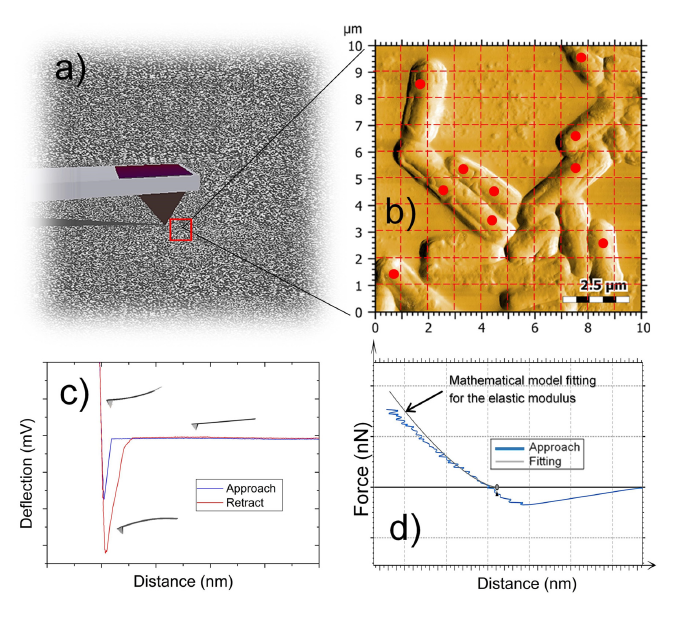
Atomic force microscopy (AFM) was used for nanomechanical and morphological characterization of bacterial cells. Measurements were performed using a commercially available AFM instrument operated in contact resonance amplitude imaging (CRAI) mode. An Nanoworld Arrow-FMR force modulation AFM probe was used. This silicon AFM probe features a rectangular beam with a triangular free end and a tetrahedral tip (tip radius ~10 nm, tip height 10–15 μm), a spring constant of 2.8 N/m and a resonance frequency of 75 kHz. Images of 10 × 10 μm² and force–distance curves were recorded at multiple locations on the bacterial surface. Nanomechanical properties, including the elastic (Young’s) modulus, were determined by fitting approach curves to the Hertzian model with an indentation depth set to 2 nm.

figure S1: Schematic representation of the 4-step procedure for the AFM analysis of the bacteria surface

Figure S1: Schematic representation of the 4-step procedure for the AFM analysis of the bacteria surface: scanning of the surface in contact resonance amplitude (CRAI) mode (a); creation of the 10-point map of the nanomechanical test (b); generation of the force-distance curves (c); and fitting procedure for the extrapolation of the elastic modulus (d).     


Taverniti, V.; D’Incecco, P.; Farris, S.; Jonsen, P. R.; Eld, H. S.; Sørensen, J.; Brunelli, L.; Mantegazza, G.; Arioli, S.; Mora, D.; Guglielmetti, S.; Frøkiær, H.
The Capacities of the Probiotic Strains L. helveticus MIMLh5 and L. acidophilus NCFM to Induce Th1-Stimulating Cytokines in Dendritic Cells Are Inversely Correlated with the Thickness of Their S-Layers.
Biomolecules 2025, 15(7), 1012.
https://doi.org/10.3390/biom15071012

The article: The Capacities of the Probiotic Strains L. helveticus MIMLh5 and L. acidophilus NCFM to Induce Th1-Stimulating Cytokines in Dendritic Cells Are Inversely Correlated with the Thickness of Their S-Layers, is licensed under a Creative Commons Attribution 4.0 International License, which permits use, sharing, adaptation, distribution and reproduction in any medium or format, as long as you give appropriate credit to the original author(s) and the source, provide a link to the Creative Commons license, and indicate if changes were made. The images or other third party material in this article are included in the article’s Creative Commons license, unless indicated otherwise in a credit line to the material. If material is not included in the article’s Creative Commons license and your intended use is not permitted by statutory regulation or exceeds the permitted use, you will need to obtain permission directly from the copyright holder. To view a copy of this license, visit http://creativecommons.org/licenses/by/4.0/.

Season’s Greetings 2025 from NanoWorld

As we glide toward the end of the year, we’d like to say a heartfelt thank you to our customers and partners around the world for trusting NanoWorld AFM probes in your research and industry related applications.

Whether you’re carving fresh tracks like the NanoWorld Professor or enjoying the view like our robot friend in the gondola in this year’s holiday cartoon, we hope this festive season brings you inspiration, well-earned rest, and exciting discoveries ahead. ☃️⛷️🚠

✨ Wishing you a joyful Christmas and a successful, curiosity-driven New Year 2026! ✨

We look forward to continuing the journey together in the year to come.

NanoWorld AFM probes holiday cartoon showing the NanoWorld professor on the left-hand side of the drawing skiing down a slope and the NanoWorld robot on the upper right-hand side sitting in a gondola together with a snowman watching the professor from above. Some mountains are drawn in the background.
Enjoy the holiday season now matter if you are hitting the slopes or have other fun plans. See you next year!