
Developing smarter fertilizer systems that deliver nutrients when and where plants need them could help improve nutrient efficiency while reducing unnecessary losses to the environment. In this article, Alice Boarino, Nicola Carrara, Joaquin Clua, Nick Zahnd, Yves Poirier, and Harm-Anton Klok present a lignin-based nanofertilizer platform designed to respond to a biological signal associated with phosphate deficiency in plants.
The researchers developed tripolyphosphate (TPP)-cross-linked lignin nanoparticles engineered to release phosphorus in response to acid phosphatase. This enzyme is upregulated by plants under phosphate-starvation conditions, providing a mechanism for synchronizing nutrient release with plant demand. The lignin/TPP nanoparticles therefore combine a biodegradable polymer-based carrier with an enzyme-responsive release mechanism rather than relying on a conventional uncontrolled release process.
The nanofertilizers were prepared from aminated lignin and tripolyphosphate through ionic gelation followed by covalent cross-linking. The resulting nanoparticles were investigated to determine their structural and functional properties and to understand how exposure to acid phosphatase affects their stability. The authors found that phosphorus release was triggered by acid phosphatase activity and occurred together with nanoparticle disintegration, demonstrating the responsiveness of the lignin-based delivery system to the targeted enzymatic stimulus.
The biological experiments further demonstrated the potential of the nanoparticles as a phosphorus source for Arabidopsis thaliana. Treatment with lignin-TPP nanoparticles suppressed the growth inhibition and molecular responses normally associated with phosphate deficiency, supporting their potential as controlled-release nanofertilizers for plant growth and development.
Atomic force microscopy (AFM) was used to characterize the morphology and size distribution of the lignin-based nanoparticles. AFM imaging was performed in tapping mode using a NanoWorld PointProbe® NCSTR-50 AFM probe, an aluminum-coated silicon cantilever with a spring constant of 7.4 N/m and a resonance frequency of approximately 160 kHz.
For AFM analysis, nanoparticle dispersions were deposited onto cleaned silicon wafers and dried overnight at room temperature. Samples prepared in Milli-Q water were used to characterize nanoparticle dimensions, while dispersions in MES buffer were used to investigate the effect of acid phosphatase on nanoparticle stability. The resulting AFM images enabled direct nanoscale characterization of the particles, with nanoparticle sizes determined from the measured particle heights.
The use of a NanoWorld AFM probe in tapping mode provided a suitable approach for imaging these nanoscale polymer-based structures while limiting the interaction between the AFM probe and the deposited nanoparticles. The NanoWorld PointProbe® NCSTR-50 AFM probe therefore played an important role in confirming the morphology and dimensions of the lignin-TPP nanofertilizers.
This work highlights how NanoWorld AFM probes can support nanoscale characterization of responsive polymer nanoparticles and advanced agricultural materials. By combining AFM-based morphological analysis with biochemical response testing and plant experiments, the authors demonstrate a promising approach toward nanofertilizers capable of delivering phosphorus in a plant-growth-synchronized manner.
The study also illustrates the broader potential of nanoscale characterization in the development of responsive agricultural materials, where nanoparticle size, morphology, stability, and stimulus-dependent behavior can all influence the performance of the final delivery system.
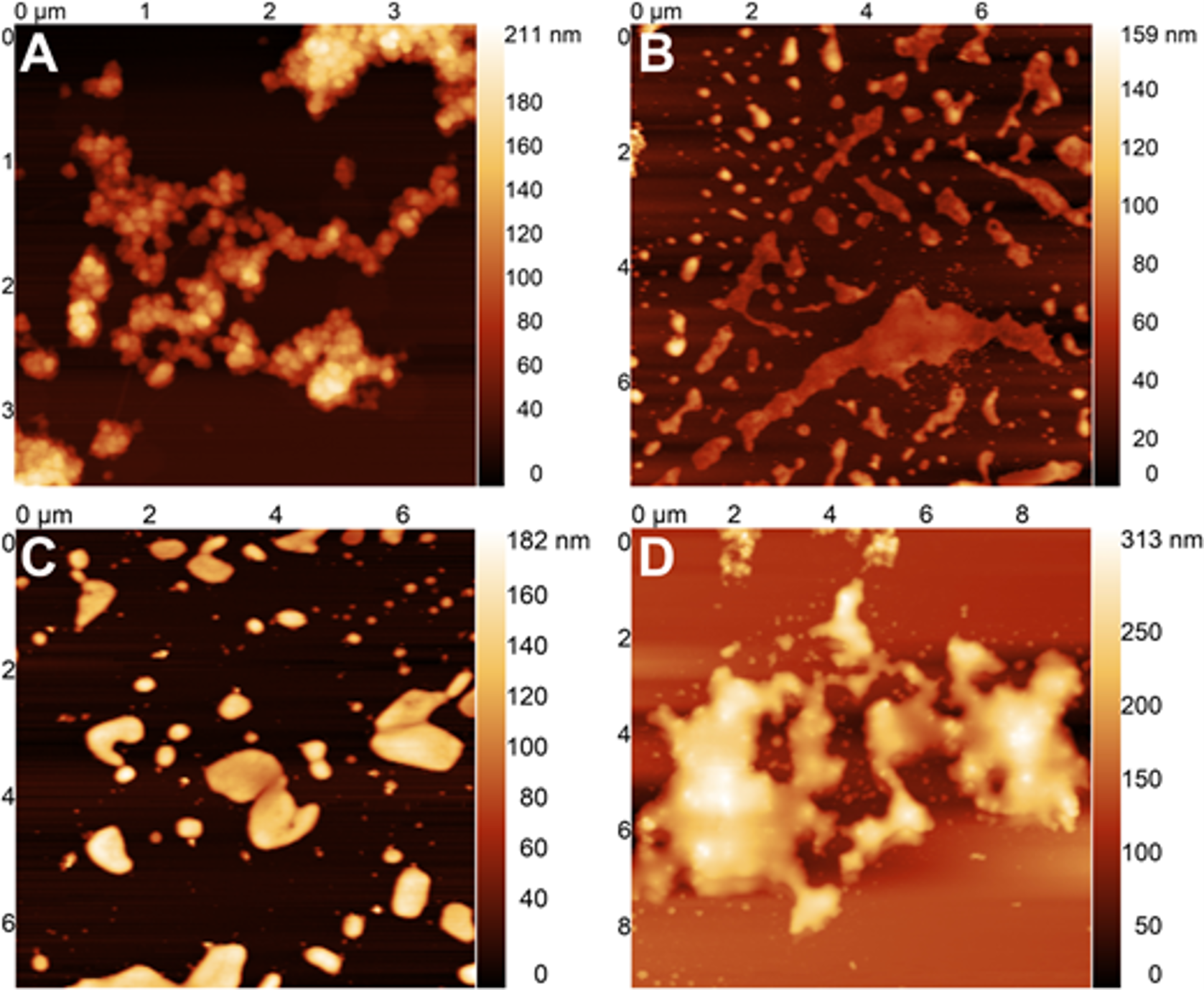
AFM images of cross-linked lignin/TPP nanoparticles after A) 0 h, B) 24 h, C) 48 h, and D) 72 h of incubation with acid phosphatase (10 mU/mL).
Full citation:
Boarino, A.; Carrara, N.; Clua, J.; Zahnd, N.; Poirier, Y.; Klok, H.-A.
Plant-Growth Synchronized, Acid Phosphatase-Responsive Lignin-Based Controlled Release Phosphorus Nanofertilizers.
Biomacromolecules 2026, 27, 5, 3176–3187.
https://doi.org/10.1021/acs.biomac.5c02594
Creative Commons license: CC BY 4.0