
What happens to the crystalline structures inside a semicrystalline polymer when the material is stretched? A study by Xabier Larrañaga and colleagues, published in Macromolecules, reveals two contrasting deformation pathways in poly(L-lactic acid) (PLLA): fragmentation, in which crystalline order is locally retained, and mechanical disintegration, in which the structure becomes substantially less ordered. Atomic force microscopy (AFM), combined with Raman spectroscopy and polarized-light microscopy, helps explain these different responses.
Physical aging and the deformation of PLLA
PLLA is a polymer whose mechanical response depends strongly on its molecular structure and processing history. In semicrystalline PLLA, ordered structures called spherulites coexist with less ordered, amorphous regions. How these components interact under mechanical stress influences whether the material fractures or undergoes plastic deformation.
An important factor is physical aging. As the amorphous polymer relaxes toward a lower-energy state over time, molecular mobility can become more restricted, making plastic deformation more difficult under the investigated conditions.
Larrañaga and colleagues examined two related aspects of PLLA deformation: the influence of controlled physical aging on the brittle-to-ductile transition of glassy PLLA, and the deformation behaviour of spherulites in semicrystalline PLLA. These were distinct experimental investigations.
In the glassy PLLA experiments, the least-aged samples exhibited a brittle-to-ductile transition at −30 °C, whereas more strongly aged samples required higher temperatures to deform in a ductile manner under the reported testing conditions.
These findings provide context for understanding the importance of the amorphous chain network in polymer deformation, while the separate semicrystalline experiments reveal how spherulites respond when the surrounding material undergoes plastic deformation.
Two deformation pathways: fragmentation and disintegration
When semicrystalline PLLA films were stretched, the researchers observed two distinct responses of the spherulites.
In fragmentation, a spherulite separates into smaller regions, while characteristic crystalline structure remains locally preserved within the fragments.
In mechanical disintegration, the response is different. The former spherulite remains recognizable, but its crystalline structure undergoes substantial disordering during deformation.
The authors interpret these contrasting pathways in terms of the mechanical interaction between crystalline regions and the surrounding amorphous chain network. They propose that connectivity through bridging polymer chains plays a role in whether crystalline domains separate into fragments or undergo more extensive structural rearrangement.
To examine these changes at a local scale, the researchers combined AFM surface imaging with mechanical measurements.
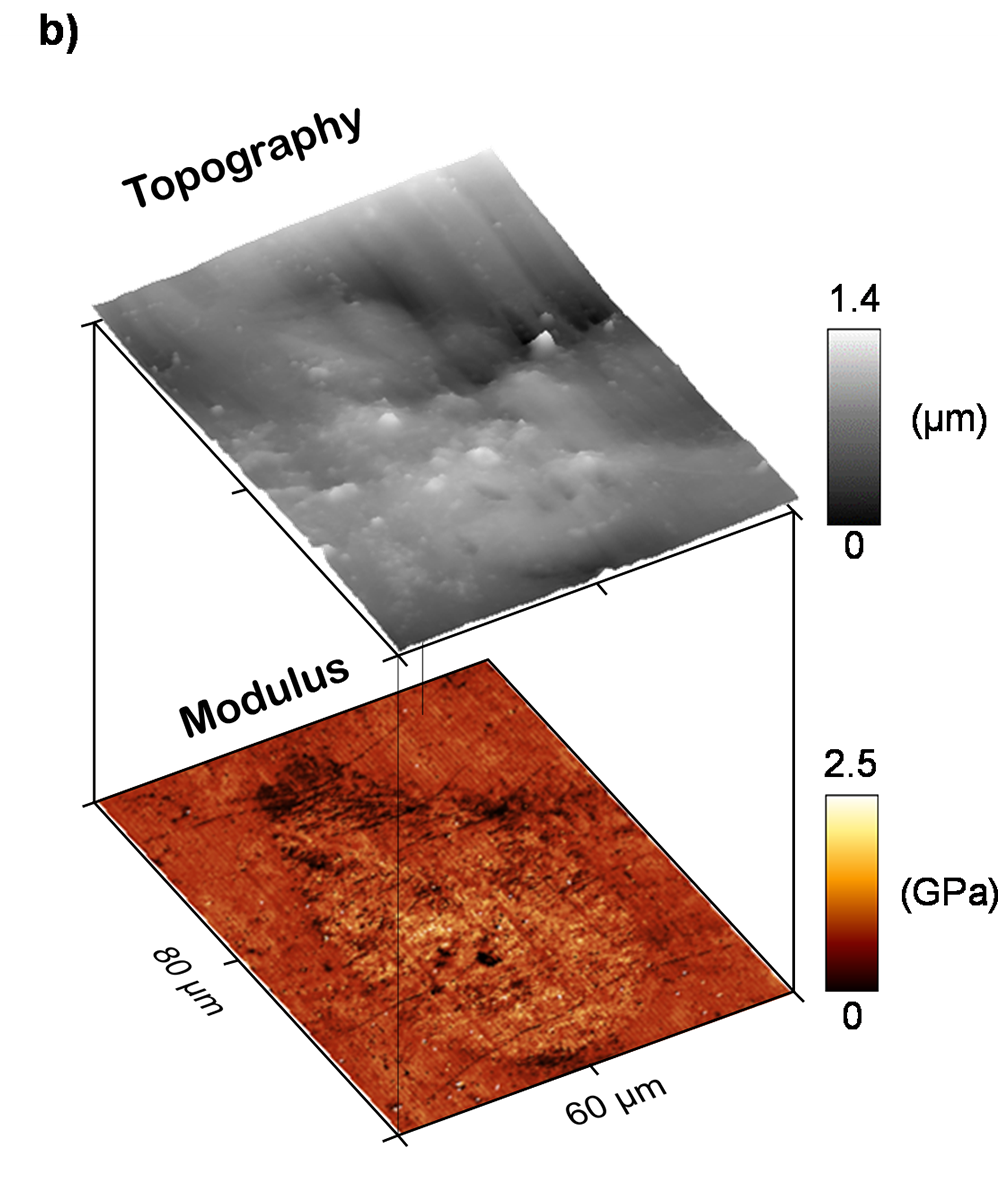
Tapping-mode AFM provided information about surface topography, while AFM force–displacement measurements and nanoindentation-derived Young’s modulus maps revealed variations in local stiffness.
Young’s modulus describes a material’s resistance to elastic deformation. Mapping this property across a deformed spherulite helps distinguish mechanically different regions that may not be apparent from surface morphology alone.
In fragmented spherulites, the AFM measurements revealed alternating regions of higher and lower stiffness. Locally stiff domains reached approximately 2.4 GPa. Together with the complementary Raman evidence, these measurements support the interpretation that crystalline regions remained within the fragments.
The mechanically disintegrated spherulites showed a different response.
Although the former spherulite could still be identified in the AFM topography, its measured stiffness was much closer to that of the surrounding amorphous material. The reported AFM-derived Young’s modulus was 1.01 ± 0.35 GPa for the disintegrated spherulite, compared with 0.92 ± 0.14 GPa for adjacent amorphous regions.
This reduced mechanical contrast is consistent with substantial structural reorganization. It does not mean that the spherulite had physically disappeared or that the two regions were mechanically identical.
AFM probes used in the study
For AFM imaging and force–displacement measurements, the authors used noncoated silicon NanoWorld Pointprobe® NCH AFM probes.
The study combined tapping-mode topography with local force measurements to examine the relationship between surface morphology and nanomechanical response in deformed PLLA.
Raman spectroscopy provides complementary structural evidence
While AFM revealed changes in morphology and local stiffness, these measurements alone could not establish whether crystalline order had been retained or lost.
The researchers therefore used polarized Raman spectroscopy to investigate changes in molecular structure.
For fragmented spherulites, Raman spectra retained characteristic signatures of crystalline PLLA within the separated regions. This supported the interpretation that fragmentation had occurred without complete loss of local crystalline organization.
In mechanically disintegrated spherulites, several characteristic crystalline Raman features disappeared or became substantially weaker. The spectra instead showed features more consistent with a deformed, less ordered molecular structure. This indicates substantial disordering rather than necessarily proving the complete disappearance of all crystalline material.
Together, the AFM and Raman results distinguish mechanical fragmentation from the more extensive structural disordering associated with spherulite disintegration. Polarized-light microscopy provided additional context for the deformation morphology.
Understanding ductility in semicrystalline polymers
The study highlights why the mechanical behaviour of PLLA cannot be understood from crystallinity alone.
The experiments on glassy PLLA demonstrate the influence of physical aging on the brittle-to-ductile transition under the investigated conditions. The separate semicrystalline experiments show how interactions between crystalline regions and the amorphous chain network are associated with contrasting deformation responses.
By combining local AFM measurements with complementary structural characterization, Larrañaga and colleagues connect changes in morphology and stiffness with their interpretation of the underlying deformation mechanisms.
The findings contribute to a more detailed understanding of how molecular organization, physical aging and interactions between crystalline and amorphous regions influence the mechanical response of PLLA.
Full Citation
Xabier Larrañaga, Brian J. Rodriguez, Jose R. Sarasua and Ester Zuza
Against the Segmental Relaxation of the Chain Network: Activating the Ductile Mechanism of Both Glassy and Semicrystalline PLLA
Macromolecules 2026
https://doi.org/10.1021/acs.macromol.6c00777
Creative Commons Attribution 4.0 International (CC BY 4.0)
https://creativecommons.org/licenses/by/4.0/