
Type: USC-F1.5-k0.6
Ultra-Short Cantilevers (for High-Speed AFM)

| Cantilever Data | Value | Range* |
|---|---|---|
| Resonance Frequency | 1500 kHz | 1200 - 1800 kHz |
| Force Constant | 0.6 N/m | 0.2 - 1.1 N/m |
| Length | 7 µm | 6 - 8 µm |
| Mean Width | 3 µm | 2.5 - 3.5 µm |
| Thickness | 0.1 µm | 0.08 - 0.12 µm |
*Typical values
This AFM probe has alignment grooves on the back side of the support chip.
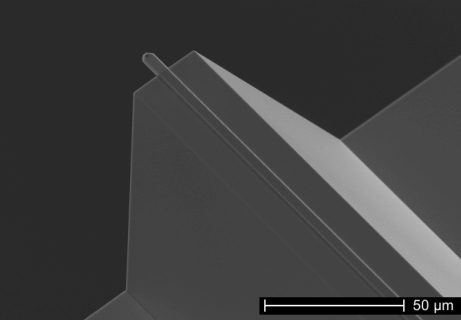
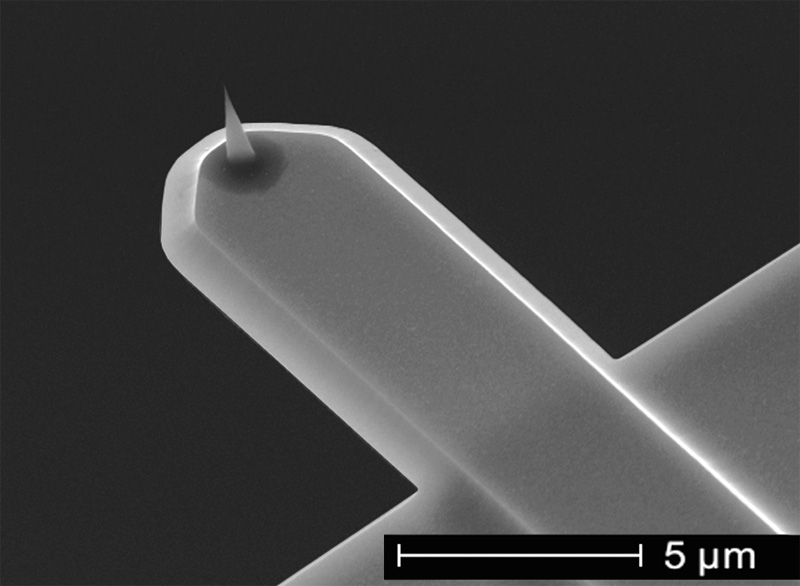
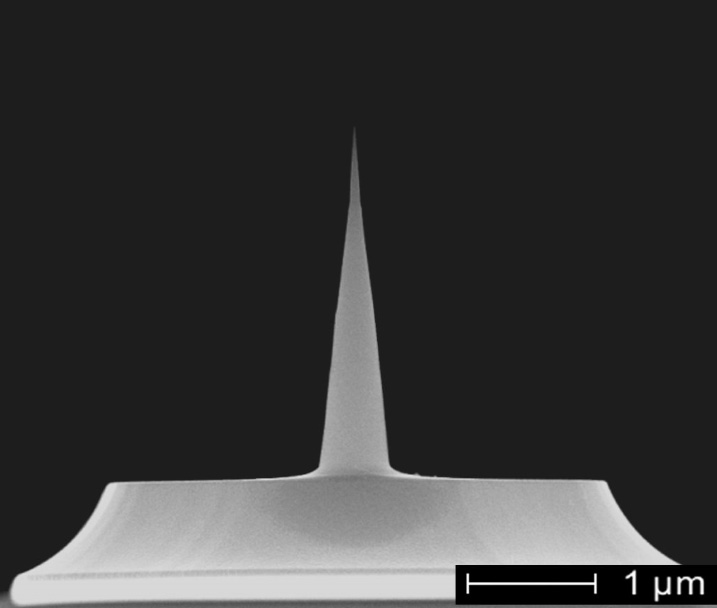
NanoWorld® Ultra-Short Cantilevers (USC) for High-Speed AFM (HS-AFM) combine very small AFM cantilevers capable of resonating in the MHz regime and a very sharp and wear resistant AFM tip.
The AFM cantilever of the USC series is rectangular and made of a quartz-like material. A gold layer is deposited on both sides of the AFM cantilever in order to enhance the reflectance of the laser beam, but the tip remains uncoated.
The wear resistant AFM tip has been developed together with nanotools GmbH and sustains high velocity scans over long distances. It is made of High Density Carbon/Diamond Like Carbon (HDC/DLC) material which is hard and wear resistant. It has a height of 2.5 microns and a radius of curvature smaller than 10 nm. The aspect ratio is in the order of 5 : 1 and the tilt compensation is 8° ensuring more symmetric AFM images.
The silicon support chip is of standard dimensions (1.6 mm x 3.4 mm x 0.3 mm). Additionally, it has etched and lowered corners in order to avoid contact between the support chip and the sample when scanning. Moreover it features alignment grooves on the back side of the silicon support chip which ensure replacement of the probes without major adjustment of the laser beam when used in conjunction with the alignment chip.
The type USC-F1.5-k0.6 is mainly designed for High-Speed AFM applications in liquid but can also be used for applications in air (depending on the application).
Tip shape: Cone Shaped
Gold Reflex Coating
The gold reflex coating consists of a 20 nm thick gold layer deposited on both sides of the AFM cantilevers which enhances the reflectance of the laser beam. Furthermore it prevents light from interfering within the AFM cantilever. As the coating is almost stress-free the bending of the AFM cantilevers due to stress is less than 2 degrees.
The tip remains uncoated.
System limitations: Due to their small AFM cantilever sizes and their very high resonance frequencies USC probes currently cannot be used in all commercially available SPMs and AFMs. Only AFMs with a sufficiently small laser spot and electronics that are capable of dealing with high resonance frequencies of up to 5 MHz are able to work with the USC probes. If in doubt whether these AFM probes can be used in your AFM please check back with us or with your AFM manufacturer.


Product Screencast NanoWorld® Ultra-Short Cantilevers (USC) for High Speed Scanning
For more information contact: info@nanoworld.com
Pointprobe® is a registered trademark of NanoWorld AG
All data are subject to change without notice.
NanoWorld AG
Rue des Saars 10
CH-2000 Neuchâtel,
Switzerland
www.nanoworld.com
For detailed information about our AFM probe product series please see below:
 POINTPROBE®
 ARROW™
 ULTRA-SHORT CANTILEVERS
 PYREX-NITRIDE
 COATINGS